
HostArmada and Hostinger occupy adjacent positions in the shared hosting market, both attracting attention for their affordable entry pricing and their generous feature sets relative to what most budget hosts provide. On the surface, both look like strong value propositions. Hostinger, founded in 2004 and headquartered in Lithuania, is one of the most widely recognized names in budget hosting globally, with millions of customers and consistently strong performance benchmarks. HostArmada, founded in 2019 and headquartered in the United States, is a significantly newer company that has built a reputation almost entirely on support quality and feature completeness at entry-level pricing. The comparison between them is genuinely competitive, and the right choice depends on which factors matter most to your specific situation.
This article covers HostArmada vs Hostinger across entry pricing and renewal rates, raw performance test data, the features included versus locked behind higher tiers, control panel experience, customer support quality, global data center coverage, and who each platform serves best. Neither provider is a clear winner across all categories, which is why the comparison exists in the first place. By the end, you will have enough information to make the choice confidently.
HostArmada vs Hostinger - Company background: established giant versus fast-growing newcomer
The age and scale difference between these two providers is significant enough to be worth understanding before comparing features, because it shapes how each company operates and what it prioritizes.
Hostinger has been operating for over two decades and currently serves tens of millions of websites globally. Its scale allows it to invest heavily in infrastructure, technology development, and aggressive pricing. Hostinger’s hPanel, its proprietary control panel, is the product of years of user experience research and iteration. The company introduced an AI website builder, AI content generator, and AI logo maker in recent years, investing in product innovation at a pace that smaller providers cannot match. Hostinger’s pricing strategy is built around high volume at low margins, which is why its introductory rates are among the lowest in the industry. The trade-off of this model is that support quality and included features at the lowest tier are calibrated for cost efficiency rather than user experience depth.
HostArmada launched in 2019 with a specific positioning strategy: compete not on price but on feature completeness and support quality at comparable price points. The company is significantly smaller than Hostinger, employing approximately 20 people as of mid-2026, which is reflected in the more personal support experience users describe in reviews. HostArmada built its reputation through word-of-mouth referrals from users who experienced its support team firsthand, which is a genuinely differentiated positioning in a market where most hosting companies compete primarily on promotional pricing. The risk of choosing a younger, smaller provider is real and worth acknowledging: business continuity over a five-year horizon is a more open question for HostArmada than for Hostinger. Users who prioritize the long-term stability of their hosting relationship should factor this into their evaluation.
HostArmada vs Hostinger pricing: introductory rates, what is included, and the renewal reality
Both providers use promotional introductory pricing that differs significantly from renewal rates. Understanding both sides of the pricing equation is essential before committing to either platform.
Hostinger’s shared hosting starts at $2.99 per month for its Premium plan on a 48-month commitment. The Business plan, which adds daily backups and better performance resources, starts at $3.99 per month on promotion. Renewal rates for Hostinger’s shared plans are substantially higher, with the Premium plan renewing at approximately $9.99 per month and the Business plan at approximately $12.99 per month. This represents a 3 to 4x increase over the promotional price. Hostinger also offers a 30-day money-back guarantee on shared hosting plans. One important detail about Hostinger’s entry plans: the Single plan, which is the cheapest option, limits you to one website and does not include daily backups, which are only available from the Business plan upward.
HostArmada’s shared hosting starts at $1.99 per month for its Start Dock plan on a 48-month commitment. The Web Warp plan, which adds more resources and supports additional websites, starts at $2.69 per month on promotion. HostArmada’s renewal rates are a consistent concern in user reviews: the Start Dock plan renews at approximately $9.99 per month, and the Web Warp plan at approximately $14.69 per month. The renewal increase is proportionally similar to Hostinger’s. HostArmada offers a 45-day money-back guarantee, which is longer than Hostinger’s 30-day window and one of the longer refund periods in the shared hosting category. One important pricing distinction: HostArmada includes daily backups, malware scanning, free site migrations, and staging environments on all plans including the entry tier, features that Hostinger locks behind higher-tier plans.
HostArmada vs Hostinger performance: speed test results and uptime data
Performance testing in the shared hosting category requires acknowledging that results vary based on server location, plan tier, and site configuration. With that context established, independent testing provides useful directional data for comparing the two platforms.
Hostinger consistently delivers strong performance results in independent testing. HostAdvice testing in 2026 recorded Hostinger outperforming HostArmada on every key speed metric: LCP (Largest Contentful Paint), TTFB (Time to First Byte), and full page load time. Independent monitoring data from hosting testing sites has recorded Hostinger’s TTFB in the 150 to 250 millisecond range on standard shared plans, with uptime tracking consistently above 99.9%. HostingStep’s 2026 benchmark data, covering October 2025 to May 2026, recorded Hostinger’s load handling at competitive levels. Hostinger’s investment in NVMe SSD storage across its Business plan and above is a meaningful performance contributor that gives it an edge over providers using standard SSD at comparable pricing. Hostinger’s data center footprint covers locations in Europe (Lithuania, Netherlands, UK), North America (US), Asia (Singapore, India, Indonesia, Japan, South Korea, Brazil), and Australia, providing one of the most extensive geographic coverage options in the budget shared hosting segment.
HostArmada’s performance is solid but does not match Hostinger’s in head-to-head testing at comparable price points. Independent testing has recorded HostArmada’s TTFB at approximately 174ms, which is fast for a shared hosting environment but below Hostinger’s results under the same testing conditions. Cybernews testing recorded HostArmada’s P95 server response time at 35ms, which is excellent, suggesting strong server-side efficiency under normal load. HostingStep’s 2026 data recorded HostArmada’s load handling response time at 32ms, which is highly competitive. The gap between the two providers on speed metrics is real but not dramatic for typical small business websites or blogs where both would deliver adequate performance. HostArmada operates data centers in Fremont, Dallas, Newark, and Los Angeles in the United States, plus locations in Europe and Asia-Pacific, giving it reasonable but less extensive geographic coverage than Hostinger.
HostArmada vs Hostinger features included at entry level: where HostArmada has a real advantage
Feature completeness at the entry tier is one of the clearest differentiators between these two platforms, and it changes the real-world cost comparison significantly once you factor in what you would pay separately for the features HostArmada includes by default.
HostArmada’s Start Dock plan, the entry-level option at $1.99 per month promotional pricing, includes daily backups with 7-day retention, free SSL certificates from Sectigo, free website migration handled by their team (up to one site), malware scanning and removal, DDoS protection, a staging environment, free domain registration, cPanel for control panel access, and unlimited email hosting. This feature set at the entry tier is more complete than what most shared hosting providers offer at mid-tier pricing. The inclusion of daily backups at the entry level is particularly notable: most budget hosts provide weekly backups at the entry tier and require plan upgrades for daily backup frequency. For a new website owner who does not want to spend time configuring add-on services or upgrading plans just to get basic protection features operational, HostArmada’s entry plan provides a complete starting point.
Hostinger’s entry-level Single plan includes free SSL, a free domain, and the hPanel control panel. Daily backups are not included on the Single plan and are only available from the Business plan upward. Malware scanning is available as an add-on. The Single plan limits users to one website. To access daily backups without paying separately, Hostinger users need the Business plan at $3.99 per month promotional pricing, which makes the true cost comparison with HostArmada’s entry plan more competitive than the headline price difference suggests. Hostinger‘s AI tools (website builder, content generator, logo maker) are a genuine feature advantage for users who want to build a website quickly without hiring a designer or developer, and they are available at lower plan tiers without additional cost.
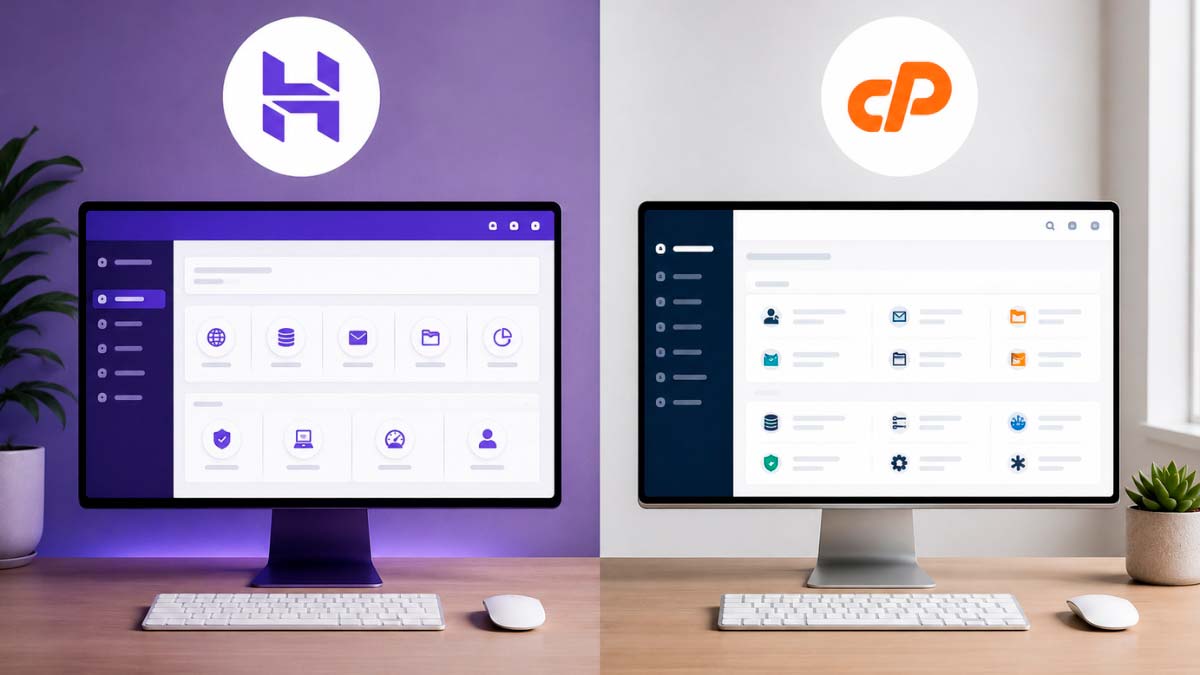
HostArmada vs Hostinger control panel: hPanel versus cPanel
The control panel determines how you interact with your hosting account on a daily basis, and the choice between Hostinger’s hPanel and HostArmada’s cPanel represents a genuine trade-off between simplicity and standardization.
Hostinger uses hPanel, a proprietary control panel it developed in-house. hPanel is designed around common user tasks rather than a comprehensive technical interface, which makes it more accessible to users with no prior hosting experience. Setting up WordPress, creating email accounts, managing domains, and accessing file management are all presented through a clean, visually organized interface that requires minimal technical knowledge to navigate. The onboarding flow in Hostinger is widely cited as one of the fastest in the industry: HostAdvice testing found that creating a new account and having WordPress running took under two minutes. For users who want to get a site live quickly without learning technical hosting concepts, hPanel‘s streamlined approach is a genuine advantage. The limitation is that hPanel is not a standard industry tool, which means guides written for cPanel-based hosting environments do not apply directly, and developers or freelancers who specialize in cPanel may need additional time to orient themselves.
HostArmada uses cPanel, the most widely used web hosting control panel in the industry. For users with any prior hosting experience, cPanel will already be familiar. For users who hire freelancers or developers to help manage their hosting, cPanel is a universal language. The extensive library of tutorials, YouTube guides, and community forums covering cPanel means that virtually any configuration or troubleshooting task you encounter has documented solutions readily available. The trade-off is that cPanel is a more complex interface than hPanel, with a larger number of options visible at once, which can be overwhelming for first-time hosting users. HostArmada’s support team partially compensates for this by providing guided setup assistance, but the initial experience for a technical newcomer is more demanding with cPanel than with hPanel.
HostArmada vs Hostinger customer support: where HostArmada is clearly superior
Customer support quality is the single most significant area where HostArmada differentiates itself from Hostinger, and the data supporting this claim is consistent across multiple independent review platforms.
HostArmada’s support team has earned a perfect 10.0 score for Quality of Support on G2, compared to Hostinger’s 8.7 on the same metric. On G2’s Technical Support category, HostArmada scores 9.9 against Hostinger’s 8.8. HostArmada’s Security Tools score 9.9 against Hostinger’s 8.6 on G2. These are not marginal differences. They reflect a consistent pattern in user experience reporting: HostArmada’s support agents respond in seconds through live chat, are knowledgeable about technical issues beyond basic account questions, and resolve problems without escalating to callbacks or ticket queues. Multiple independent reviewers describe submitting a support chat and receiving a response from a qualified agent within 15 to 30 seconds. The team has also consistently been described as non-pushy, meaning agents focus on solving the reported problem rather than attempting to upsell a plan upgrade during the support interaction.
Hostinger’s support has improved significantly over the years but still trails HostArmada’s in user satisfaction metrics. Hostinger offers 24/7 live chat and an AI chatbot for initial queries. The AI assistant handles common questions and account operations without waiting for a human agent, which reduces wait times for standard queries. However, complex technical issues that require human judgment take longer to resolve at Hostinger than at HostArmada, and some users report frustration with being cycled through automated responses before reaching a human. Hostinger does not offer phone support. HostArmada offers phone support, ticket support, and 24/7 live chat. For users who need the option to speak directly with a support agent rather than using chat, HostArmada is the only option between these two.
HostArmada vs Hostinger security features: comprehensive versus modular
Security features at entry-level shared hosting are an area where the two platforms take structurally different approaches that affect both the out-of-the-box security posture and the total monthly cost if you need comprehensive protection.
HostArmada includes a comprehensive security stack on all plans without additional charges. This covers free SSL certificates from Sectigo on all hosted domains, daily automated backups stored remotely with 7 to 21 day retention depending on plan, DDoS protection at the server level, active malware scanning and removal, live server monitoring, a Web Application Firewall, and two-factor authentication for account access. The malware scanning and removal service is particularly valuable: it runs automatically without requiring user configuration, and the removal process is handled by HostArmada’s team rather than requiring the account holder to interpret scan results and take corrective action. For a small business owner without technical staff, this comprehensive hands-off security package removes the burden of active security management.
Hostinger’s security offering is modular rather than all-inclusive at the entry level. Free SSL via Let’s Encrypt is included on all plans. DDoS protection is provided at the server level. Weekly backups are included on the Premium plan, with daily backups available from the Business plan. Malware scanning is available as a paid add-on called Malware Scanner, priced separately from the hosting plan. Two-factor authentication is supported. Hostinger’s security tools score of 8.6 on G2 versus HostArmada’s 9.9 reflects the difference between a modular approach that requires configuration and an all-inclusive approach that is active from day one. For users who plan to add security add-ons separately anyway, Hostinger’s modular approach may cost less in total than HostArmada’s all-inclusive pricing when renewal rates are compared. For users who want everything active without configuration, HostArmada’s entry-level security package delivers more immediately.
HostArmada vs Hostinger - Money-back guarantee and commitment flexibility
Both platforms offer money-back guarantees that allow new customers to evaluate the service before fully committing, but the terms differ in ways that matter for users who want more evaluation time.
HostArmada offers a 45-day money-back guarantee on shared hosting plans. This is among the longer refund windows in the shared hosting category, providing meaningful time to test performance, support quality, and feature accessibility with real-world usage before the refund option closes. HostArmada does not require users to justify their refund request, and the process is handled through support without requiring lengthy escalation.
Hostinger offers a 30-day money-back guarantee on shared hosting plans, which is the standard refund window for the category. The guarantee covers the hosting fees but not the domain registration fee, which is non-refundable as is standard across the industry. For users who want more than 30 days to evaluate a hosting provider, HostArmada’s 45-day window provides an additional two weeks of risk-free testing.
HostArmada vs Hostinger scalability: growth path beyond shared hosting
Both HostArmada and Hostinger offer hosting products beyond shared plans, but the paths for growth differ in breadth and maturity between the two providers.
Hostinger’s product line extends from shared hosting through WordPress hosting, cloud hosting, and VPS hosting. Hostinger’s VPS plans are notably affordable compared to most competitors, starting at approximately $5.99 per month for entry configurations. The VPS product uses KVM virtualization and provides root access, giving technically capable users full server control at a price point that undercuts many dedicated VPS providers. Hostinger’s cloud hosting plans provide dedicated resources at a middle tier between shared and VPS, serving sites that have outgrown shared resource pools but do not yet need full VPS management. The breadth of Hostinger’s product line means that a site can scale through multiple growth stages without changing hosting providers, maintaining the same billing relationship and the same hPanel interface throughout.
HostArmada’s product line includes shared hosting, cloud SSD shared hosting (which provides better resource isolation than standard shared plans), WordPress hosting, and VPS hosting. The VPS tier uses cPanel or DirectAdmin as control panels, which is consistent with the shared hosting experience. HostArmada’s VPS plans are priced higher than Hostinger’s entry VPS options, which is a consideration for cost-conscious users who anticipate needing VPS infrastructure within the near term. The cloud SSD shared hosting tier is a useful intermediate step: it provides cloud-based resource allocation rather than standard shared infrastructure, offering better performance isolation than standard shared plans without the full complexity of VPS management.
HostArmada vs Hostinger migration: moving to or from each platform
Site migration is a practical consideration both for users moving existing websites to one of these platforms and for users evaluating what moving away would involve in the future.
HostArmada includes free site migration as a standard feature on all plans. The migration is handled by HostArmada’s team, not through a self-service tool, which means a qualified technician performs the transfer and verifies the site is functioning correctly on the new server before the migration is considered complete. The number of free migrations varies by plan: the Start Dock plan includes one free migration, with higher tiers offering more. The team-handled approach reduces the risk of migration errors for users without technical experience, and the inclusion of this service at the entry tier without additional cost is a genuine differentiator. Most competing providers either charge for migrations, limit them to higher plan tiers, or provide self-service tools rather than managed team migrations.
Hostinger offers one free website migration for new accounts. The migration process is handled by a dedicated migration team upon request. The migration is available regardless of plan tier, which means even entry-level users can access this service. Hostinger’s migration team performs the file and database transfer and assists with DNS configuration. For users with multiple sites who need to migrate a portfolio simultaneously, Hostinger’s single free migration may require paying for additional migrations beyond the first, while HostArmada’s higher-tier plans provide more free migration slots upfront. For agencies or users managing many sites in a migration scenario, comparing the per-site migration cost of each provider is worth including in the overall cost evaluation.
The verdict: price and speed versus features and support
Hostinger is the better choice for users who prioritize the lowest possible introductory pricing, need the fastest raw page load speed at budget price points, want the most extensive global data center coverage in the shared hosting category, or prefer a beginner-friendly proprietary control panel that minimizes the learning curve for a first-time website owner. Hostinger’s AI-powered tools for website building, content generation, and logo creation are also a genuine differentiator for users who want to build and manage a website without relying on external design resources. At the Business plan tier where daily backups are included, Hostinger represents strong all-round value for a solo operator or small business running one to a few websites.
HostArmada is the better choice for users who want the most complete feature set at the entry-level price without needing to upgrade for daily backups, malware scanning, staging environments, or free migrations, who place high value on support quality and want the fastest response times and highest technical competence in the hosting category at this price point, who are comfortable with cPanel and want the portability and documentation advantages of the industry-standard control panel, or who want a longer refund period to evaluate the platform. HostArmada’s security and support model make it particularly well-suited for small business owners who do not have technical staff and need a hosting provider that handles protective functions proactively rather than requiring manual setup and add-on purchases.
For users managing multiple WordPress sites who are price-sensitive and performance-focused, Hostinger’s Business plan at promotional pricing is hard to beat on a per-site basis. For users who want maximum built-in protection and best-in-class support quality without configuring add-ons, HostArmada delivers a more complete experience at a slightly higher effective price once you account for the features included in its entry tier that Hostinger charges separately for.
Sources and references consulted: hostarmada.com, hostinger.com, g2.com, trustpilot.com, vpsbenchmarks.com.
Frequently asked questions about HostArmada vs Hostinger
Yes, by a significant margin in user satisfaction data. HostArmada scores a perfect 10.0 for Quality of Support on G2, compared to Hostinger's 8.7. HostArmada's live chat connects to a qualified technical agent within seconds, and reviewers consistently describe agents as knowledgeable and non-pushy. HostArmada also offers phone support, which Hostinger does not provide at any tier.
Hostinger edges ahead on raw speed metrics in most independent tests. HostAdvice 2026 testing recorded Hostinger outperforming HostArmada on LCP, TTFB, and full page load time at comparable pricing tiers. HostArmada delivers solid performance with a 174ms TTFB and a 32ms load handling response time, but Hostinger's NVMe storage and infrastructure investment gives it a measurable speed advantage.
Yes. Daily backups with 7-day retention are included on HostArmada's Start Dock entry plan without needing to upgrade. Hostinger only includes daily backups from the Business plan upward. This feature difference is relevant when comparing the true value of entry-level plans from both providers.
No. Hostinger uses its proprietary hPanel control panel. HostArmada uses cPanel. hPanel is more beginner-friendly and streamlined. cPanel is the industry standard with universal documentation, tutorial resources, and freelancer familiarity. The right choice depends on whether ease of use or portability of knowledge matters more to you.
HostArmada offers a 45-day money-back guarantee on shared hosting plans, which is longer than Hostinger's 30-day window. The extended window gives new users additional time to evaluate performance, support quality, and feature access with real-world usage before the refund option closes.
HostArmada has maintained strong uptime performance in independent monitoring, consistently recording 99.9% to 99.95% availability. The company launched in 2019 and has grown steadily on strong user reviews. The risk of choosing a newer, smaller provider compared to an established platform like Hostinger is a legitimate consideration for users prioritizing long-term hosting stability, though HostArmada's track record to date does not indicate reliability concerns.
Hostinger has significantly more data center locations. Hostinger operates in Europe, North America, Asia, and Australia across a dozen or more locations. HostArmada operates data centers in four US locations (Fremont, Dallas, Newark, Los Angeles) and select European and Asia-Pacific locations, providing adequate but less extensive geographic coverage than Hostinger.
Yes. Malware scanning and removal is included on all HostArmada plans including the entry-level Start Dock tier. Hostinger offers malware scanning as a paid add-on rather than a standard feature at entry-level pricing. For users who want active malware protection without purchasing additional services, HostArmada's all-inclusive approach is the more cost-effective option.