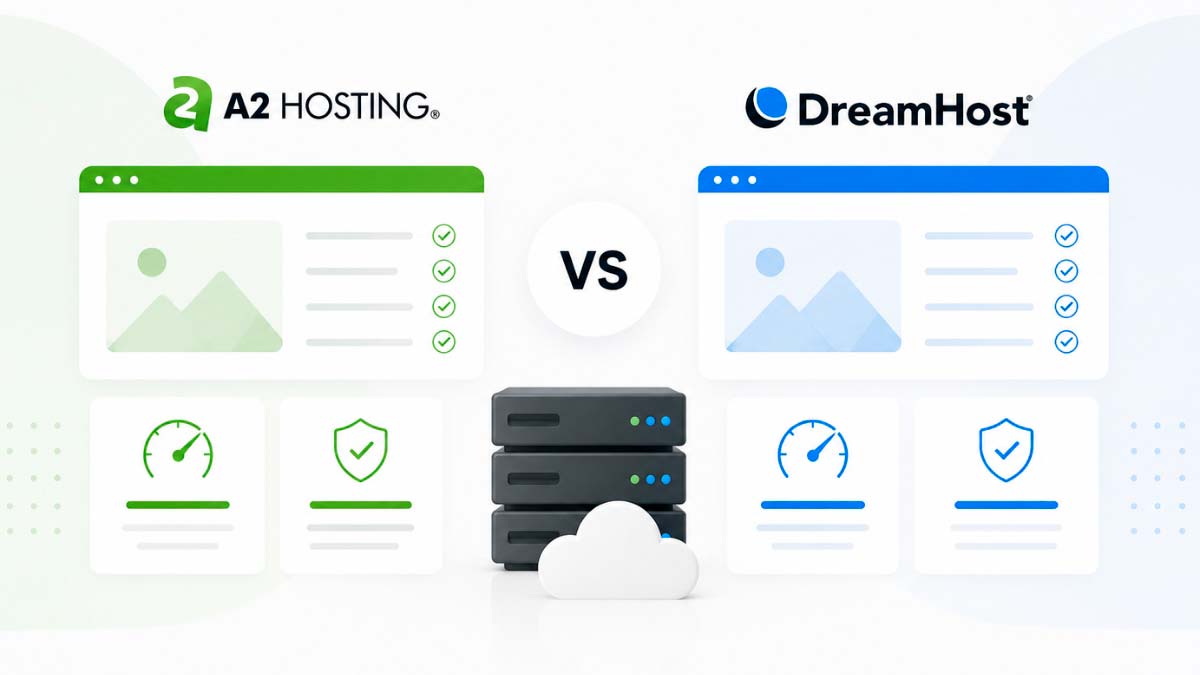
A2 Hosting vs DreamHost are two of the most consistently recommended shared hosting providers in the United States. Both have been operating for over two decades, both attract strong loyalty from long-term customers, and both sit in a price range that makes them realistic options for individuals, bloggers, and small businesses looking for reliable entry-level hosting. But comparing them in 2026 requires knowing one piece of context that most reviews have not updated: A2 Hosting recently rebranded to hosting.com under its new parent company, World Host Group. The change is mostly cosmetic for existing customers, but it signals a shift in the company’s strategic direction that is worth understanding before you commit to a long-term plan.
This comparison covers A2 Hosting (now hosting.com) vs DreamHost across the dimensions that matter most for a shared hosting decision: plan pricing and renewal costs, performance and uptime test results, control panel experience, features included in base plans, customer support quality and availability, money-back guarantees, and scalability when your site eventually outgrows shared hosting. By the end, you will have a clear picture of which provider fits which type of user, based on what each one actually delivers rather than marketing claims.
The name change you need to know about: A2 Hosting is now hosting.com
A2 Hosting, the Ann Arbor, Michigan-based provider founded in 2001, has been acquired by World Host Group and rebranded as hosting.com. The rebrand is described by the company as primarily cosmetic: existing A2 Hosting plans continue to operate under the same infrastructure, the same support team (marketed as the Guru Crew), and the same technical specifications. Customers with active A2 Hosting accounts do not need to take any immediate action. Domain names, email accounts, and websites continue to function without interruption.
What the rebrand does signal is a repositioning of the brand’s strategic focus. Under World Host Group, hosting.com is described as targeting solo developers, LMS users, and small businesses with streamlined hosting solutions. The company no longer appears to be leading with raw performance as its primary value proposition in the way A2 Hosting historically did. The Turbo server plans, which were A2 Hosting’s flagship differentiator, are still available and still offer the LiteSpeed caching and NVMe storage that made them stand out. But readers evaluating this provider in 2026 should be aware that they are buying into a brand in transition, not a static, fully established product line.
A2 Hosting vs DreamHost - Shared hosting plans: what each provider offers
A2 Hosting (hosting.com) offers shared hosting in three tiers. The Startup plan covers a single website with 100GB of SSD storage. The Drive plan covers unlimited websites and adds unlimited storage. The Turbo Boost and Turbo Max plans add LiteSpeed server technology, NVMe storage, and significantly faster CPU resources compared to standard shared hosting. The Turbo plans are where A2 Hosting has historically made its strongest case against competitors. Introductory pricing for the Startup plan starts at approximately $1.99 per month on a promotional basis for a 36-month commitment, but renewal rates are substantially higher, typically reaching $10.99 to $11.99 per month depending on the plan. This renewal gap is one of the most consistent criticisms users raise about A2 Hosting.
DreamHost offers shared hosting in two primary tiers: Shared Starter and Shared Unlimited. The Shared Starter plan covers one website with unlimited storage and a free domain, but notably does not include email hosting, which must be added separately or accessed through a higher-tier plan. The Shared Unlimited plan adds unlimited websites and includes email. DreamHost’s introductory pricing starts at $1.99 per month, making it directly comparable to A2 Hosting at the entry level. Renewal pricing for DreamHost’s shared plans is more predictable and generally lower than A2 Hosting’s renewal rates, a difference that matters significantly over a multi-year hosting relationship. DreamHost offers a 97-day money-back guarantee on shared hosting, which is the longest money-back window of any major hosting provider currently operating in the US market.
A2 Hosting vs DreamHost - Performance and uptime: independent test results
Performance testing in the shared hosting category needs to be interpreted carefully because shared hosting environments are inherently variable. Multiple customers share the same server resources, which means your site’s speed and response time can be affected by the activity of neighboring accounts. With that context established, independent testing data provides useful directional guidance even if it cannot predict the exact performance you will experience on your specific account.
A2 Hosting’s standard shared servers have recorded uptime rates of 99.9% to 99.99% in independent monitoring tests conducted over extended periods. The Turbo plan servers, which use LiteSpeed caching and NVMe storage, consistently outperform the standard shared plans on load time tests. Independent testing from sources including GTmetrix and Bitcatcha has recorded average server response times of around 400 to 600 milliseconds for A2 Hosting’s standard shared accounts. The Turbo plans bring this down substantially, with some tests recording response times under 300 milliseconds. A2 Hosting also operates data centers in four locations: two in the United States (Michigan and Arizona), one in Amsterdam, and one in Singapore, which gives it an advantage for websites targeting audiences outside North America.
DreamHost’s uptime performance is one of its strongest selling points. DreamHost offers a 100% uptime guarantee, which is more ambitious than the 99.9% SLA offered by most hosting providers. In independent testing, DreamHost has recorded uptime rates of 99.99% with minimal downtime incidents. The company’s server response time, however, has been measured at around 200 to 230 milliseconds in independent tests, which is actually faster than A2 Hosting’s standard servers on this metric. Where DreamHost falls short compared to A2 Hosting’s Turbo plans is in raw page load speed, because DreamHost’s standard plans use conventional SSD storage and do not include LiteSpeed caching by default. DreamHost does offer caching through Jetpack on WordPress hosting plans, but this feature is not available across all shared plan tiers.
A2 Hosting vs DreamHost - Control panel experience: cPanel versus DreamHost's custom panel
Control panel choice has a significant practical impact on your hosting experience, particularly if you are new to managing web hosting or if you plan to hire a freelancer or developer to help with your site at some point. The control panel is where you manage file uploads, create email accounts, set up databases, install applications, manage domains and subdomains, configure SSL certificates, and access all the technical functions of your hosting account.
A2 Hosting uses cPanel on its Linux shared hosting plans, and also offers Plesk on plans that support Windows hosting. cPanel is the industry standard control panel, used by more shared hosting providers than any other system. It is thoroughly documented, familiar to the vast majority of web developers and freelancers, and supported by an enormous library of tutorials, YouTube walkthroughs, and community forums. If you encounter a problem with your hosting configuration, there is almost certainly a well-documented solution available specifically for cPanel. A2 Hosting’s implementation of cPanel includes Softaculous, which provides one-click installation of WordPress and hundreds of other web applications.
DreamHost does not use cPanel. Instead, it has developed a proprietary control panel that was designed from the ground up to be more intuitive and less cluttered than cPanel. For users with no prior hosting experience, DreamHost’s panel can actually be easier to navigate on first use. The layout is cleaner and puts the most commonly used functions in more accessible positions. The limitation of DreamHost’s custom panel is the same limitation that affects any non-standard control panel: it is not the industry norm. Guides written for cPanel do not apply to it. Freelancers and developers who are unfamiliar with DreamHost’s panel may need additional time to orient themselves. And if you ever decide to move your site to a different hosting provider, you will be migrating to a cPanel environment where DreamHost’s panel knowledge does not transfer.
A2 Hosting vs DreamHost - Features included in the base plans
The features included in a shared hosting plan at the base price determine whether you need to spend additional money before your site can actually launch. Both A2 Hosting and DreamHost include a free SSL certificate with all shared hosting plans, which is the minimum expectation in 2026. Both providers include unlimited bandwidth, meaning you will not face overage charges if your site receives an unexpected spike in traffic. Both include one-click WordPress installation, which is the most common use case for shared hosting among new website owners.
Where the two providers diverge meaningfully is on email hosting. DreamHost does not include email hosting with its entry-level Shared Starter plan. If you need a professional email address at your domain, you either need to upgrade to the Shared Unlimited plan or add email hosting as a separate paid service. This is a meaningful additional cost consideration that is frequently overlooked when people compare headline pricing between the two providers. A2 Hosting includes unlimited email hosting with all shared hosting plans, which means your business email is operational from day one without additional fees.
A2 Hosting also includes free malware scanning and DDoS protection on all shared plans. DreamHost charges separately for malware scanning through its DreamShield service, which adds approximately $3 per month to the base plan cost. Free website migration is included on paid A2 Hosting plans, handled by their Guru Crew support team. DreamHost does not include free migration on shared plans, though it does offer a paid migration service. If you are moving an existing website to a new host, the migration support difference is practically significant and worth factoring into your total cost calculation.
More hosting intelligence

A2 Hosting vs DreamHost - Customer support: Guru Crew versus DreamHost's callback-only phone support
Customer support is one of the most important practical differentiators between hosting providers because it is the resource you rely on when something goes wrong with your site at an inconvenient time. Both A2 Hosting and DreamHost offer 24/7 support, but the channels available and the conditions under which each channel is accessible differ in ways that matter to different types of users.
A2 Hosting’s support team, known as the Guru Crew, is available 24/7/365 through phone, live chat, email, and a ticketing system. Phone support is included with all hosting plans at no additional charge. This means that if you have an urgent issue at 2am on a Saturday, you can call and speak directly with a support representative without paying an add-on fee or navigating a callback queue. User reviews of A2 Hosting’s support are generally positive on response time and technical depth, though some reviews on G2 and Trustpilot note variability in experience depending on the specific agent. The Guru Crew branding reflects a genuine emphasis on technical support quality that A2 Hosting has maintained consistently over its history.
DreamHost’s support model is structured differently. Live chat and email ticketing are available 24/7 and are included with all plans. Phone support is not available as a direct inbound call option. DreamHost offers a callback request system, where you can request that a support agent call you at a time you specify. This callback-only approach is a genuine limitation for users who need immediate assistance with a critical site issue and cannot afford to wait for a scheduled callback. DreamHost also sells a priority support add-on that advertises shorter wait times, but this is an additional paid service rather than a standard feature. For users who rarely need support and prefer to work through documentation and chat, DreamHost’s model is workable. For users who want the option of immediate phone contact, A2 Hosting is the stronger choice.
A2 Hosting vs DreamHost pricing at renewal: the number that actually matters
The introductory pricing that hosting providers advertise is almost always a discounted rate available only for the first billing term, typically requiring a commitment of one to three years to access. The renewal price you pay when that term ends is the price you will pay for the rest of your time with that provider, unless you cancel and start a new promotional term, which some providers allow and others do not. Understanding the renewal price is more important than the introductory rate for evaluating the long-term cost of a hosting relationship.
A2 Hosting’s renewal rates are among the steeper in the shared hosting category. The Startup plan, which starts at approximately $1.99 per month on promotion, renews at approximately $10.99 per month. The Drive plan renews at approximately $11.99 per month. The Turbo Boost plan, which delivers the best performance in A2 Hosting’s lineup, starts around $5.99 per month on promotion and renews at around $15.99 per month. These renewal rates represent significant increases over the promotional price, and represent the most common source of customer complaints about A2 Hosting across review platforms.
DreamHost’s renewal pricing is more transparent and represents a smaller percentage increase over the introductory rate. The Shared Starter plan renews at approximately $7.99 per month, and the Shared Unlimited plan renews at approximately $12.99 per month. For users planning to stay with a hosting provider for multiple years, DreamHost’s lower renewal rates translate to a meaningful long-term cost advantage over A2 Hosting’s standard shared plans. The Turbo plans from A2 Hosting command a premium that may be justified for performance-intensive sites, but for standard WordPress blogs and small business websites, DreamHost’s renewal economics are more favorable over a three to five year horizon.
Who should choose A2 Hosting (hosting.com) in 2026
A2 Hosting is the better choice for users who need phone support available at any hour without an additional fee, who are targeting audiences in Asia or Europe and want data center proximity in those regions, who run performance-intensive WordPress sites and want the Turbo plan’s LiteSpeed caching and NVMe storage, or who need email hosting included in the base plan without paying extra. Developers who are comfortable with cPanel and want access to a broader set of developer tools including staging environments on all plans will also find A2 Hosting more accommodating. The caveat is that the renewal pricing requires careful planning: a three-year introductory term followed by renewal at double or triple the initial rate is a real budgeting consideration.
Who should choose DreamHost in 2026
DreamHost is the better choice for users who prioritize uptime guarantee strength over raw speed, who are building WordPress-focused sites and want a host with official WordPress.org recommendation status, who value long-term pricing predictability and lower renewal rates, or who want the longest money-back guarantee in the industry at 97 days. DreamHost is also a stronger fit for users who are comfortable managing hosting through a custom control panel and who do not need immediate inbound phone support. Bloggers, nonprofits, portfolio sites, and small businesses that serve primarily US-based audiences will find DreamHost’s infrastructure and price structure well-matched to their needs.
A2 Hosting vs DreamHost - The verdict: speed versus stability and long-term value
In a direct comparison, A2 Hosting’s Turbo plans outperform DreamHost on raw page load speed and offer broader global data center coverage. DreamHost outperforms A2 Hosting on uptime guarantee strength, long-term pricing predictability, and money-back guarantee duration. On control panel, A2 Hosting’s use of cPanel gives it a practical edge for users who will ever hire outside help or need to transfer their knowledge to another host. On email hosting, A2 Hosting’s inclusion of email at the base plan level avoids a friction point that DreamHost’s entry tier creates for users who need professional email from day one.
Neither provider is objectively superior across all categories. The right choice depends on which specific factors matter most to your situation. If performance and phone support accessibility are your top priorities, A2 Hosting on a Turbo plan is the stronger option despite the higher renewal cost. If long-term pricing stability, uptime reliability, and a risk-free 97-day evaluation window are more important, DreamHost is the more defensible choice for a standard shared hosting deployment.
A2 Hosting vs DreamHost - Security features: what each provider includes by default
Security at the shared hosting level is a topic most comparison articles undercover, but it has a direct impact on whether your site stays online, stays clean, and stays trusted by browsers and search engines. The security features included by default in a shared hosting plan determine your baseline protection without requiring additional spending or third-party plugin installations.
A2 Hosting includes free SSL certificates via Let’s Encrypt on all shared hosting plans, automatic WordPress security updates on managed WordPress plans, free malware scanning and removal through its HackScan tool, DDoS protection at the server level, and a Web Application Firewall (WAF) that filters malicious traffic before it reaches your site. These security features are active by default and do not require any additional configuration to provide baseline protection. The Guru Crew support team also has a documented process for helping customers whose sites have been compromised, which reduces recovery time compared to hosting providers where security incidents are handled entirely through automated tools.
DreamHost’s security baseline includes free SSL via Let’s Encrypt on all plans, automated WordPress core updates on managed plans, and server-level firewalls. However, malware scanning and removal is not included in the base price. DreamHost offers its DreamShield security add-on, which provides automated malware scanning, at an additional cost of approximately $3 per month. DDoS protection is available but is not explicitly included at the same coverage level as A2 Hosting’s standard plans. For users who want comprehensive malware protection without paying extra, A2 Hosting’s security package represents a meaningful cost advantage over DreamHost once the DreamShield add-on cost is factored into a comparison.
Sources and references consulted: Google PageSpeed Insights, gtmetrix.com, web.dev, g2.com, dreamhost.com.
Frequently asked questions about A2 Hosting vs DreamHost
Yes. A2 Hosting rebranded to hosting.com in 2026 after being acquired by World Host Group. The infrastructure, support team, and hosting plans remain substantially the same. Existing A2 Hosting customers do not need to take any action. New customers signing up will encounter the hosting.com branding rather than the A2 Hosting name.
Not on the entry-level Shared Starter plan. DreamHost's Shared Starter plan requires you to add email hosting separately for an additional monthly fee. The Shared Unlimited plan includes email. This distinction matters if you need a professional domain email address from the start, as A2 Hosting includes unlimited email on all shared plans by default.
The Turbo plan is A2 Hosting's performance tier that uses LiteSpeed web server technology, NVMe storage, and additional CPU resources compared to standard shared hosting. Independent speed tests consistently show faster page load times on Turbo servers. It is worth paying for if you run a WordPress site with multiple plugins, an ecommerce store, or any site where page load speed is a direct business concern.
DreamHost's 100% uptime guarantee is backed by a credit policy: if your site experiences downtime that falls below 100% availability, you are eligible for a credit on your hosting account. In practice, independent monitoring has recorded DreamHost uptime at 99.99%, with very few extended outages. The guarantee is more ambitious than the 99.9% SLA standard, though the credit compensation for failure is the mechanism rather than a contractual guarantee of zero downtime.
A2 Hosting has a more accessible support model. Phone support is included 24/7 with all plans at no extra cost. DreamHost offers live chat and email support but requires a callback request for phone contact and does not offer a direct inbound number. For users who want the option of immediate phone support at any hour, A2 Hosting is the stronger choice.
DreamHost's renewal rates are lower and more predictable. A2 Hosting's renewal rates represent a significant increase over promotional pricing, with standard plans renewing at approximately $10.99 to $11.99 per month. DreamHost's shared plans renew at approximately $7.99 to $12.99 per month depending on the tier, making DreamHost more cost-efficient over a multi-year hosting relationship.
A2 Hosting offers a 30-day money-back guarantee on shared hosting plans. DreamHost's 97-day money-back guarantee is significantly longer and gives new users more time to evaluate the service with real-world usage before the refund window closes. If evaluation time matters to your decision, DreamHost's guarantee is the more protective option.
A2 Hosting has a meaningful advantage for international audiences. It operates data centers in the US (Michigan and Arizona), Amsterdam, and Singapore. Choosing a data center geographically close to your primary audience reduces server response time for those visitors. DreamHost operates data centers only in the United States, making it best suited for sites targeting US-based audiences.