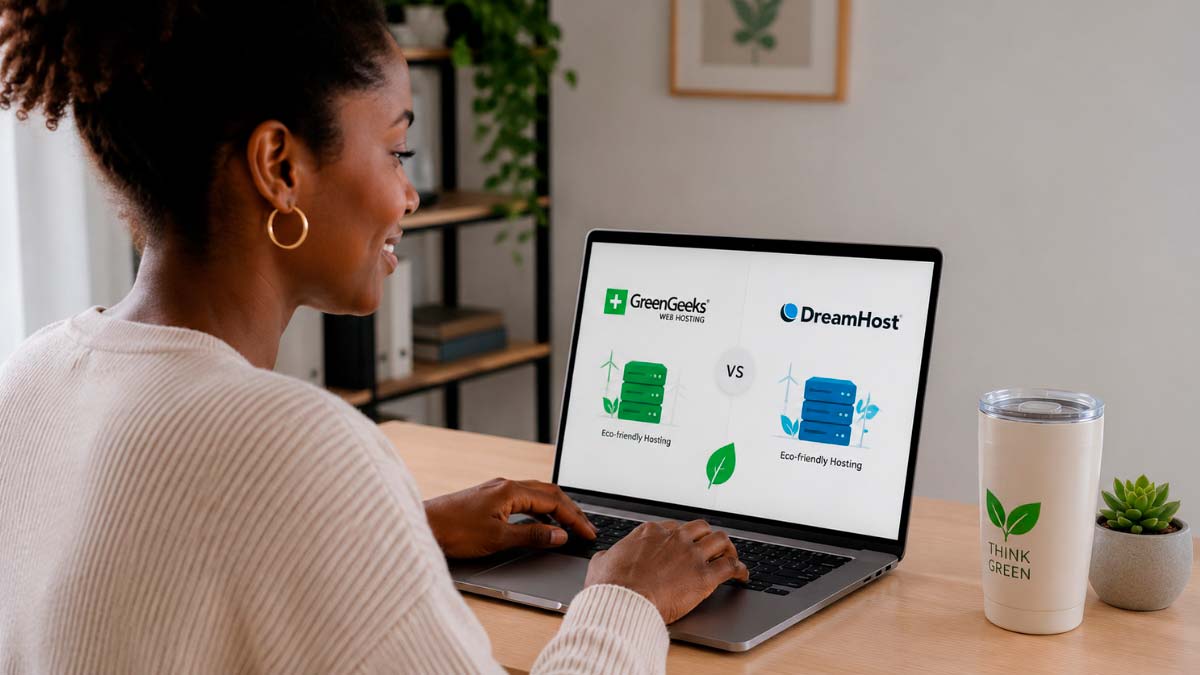
GreenGeeks and DreamHost are the two names that come up most often when someone searches for eco-friendly web hosting. Both have genuine environmental credentials, both offer competitive shared hosting pricing, and both have been operating long enough to have real track records rather than just marketing claims. But the comparison between them involves more than a choice between two green-branded products. The platforms are built differently, they approach sustainability differently, and they serve different user profiles even when the decision is framed entirely around environmental responsibility.
This article covers GreenGeeks vs DreamHost across what the green credentials actually mean and how they compare, server technology and the LiteSpeed versus Apache question, performance test data from independent sources, pricing at both promotional and renewal rates, the features included at each plan tier, control panel experience, customer support quality and channels, the 97-day money-back guarantee that DreamHost offers and what makes it unusual, and the verdict on which platform fits which use case. The environmental comparison receives more detailed treatment than most articles provide, because understanding what RECs actually are and what a 300% offset means in practice changes how you evaluate both providers.
The green credentials: what 300% renewable energy actually means
Both GreenGeeks and DreamHost market themselves as eco-friendly hosting providers, but the substance of their environmental programs differs significantly, and understanding the mechanism behind their claims is important before accepting either at face value.
GreenGeeks purchases Renewable Energy Certificates (RECs) at 300% of its total energy consumption, through the Bonneville Environmental Foundation. This means that for every unit of electricity its data centers consume, GreenGeeks funds the production of three units of renewable energy that get added to the electrical grid. The result is described as carbon-negative operation: the company offsets the equivalent of three times its own footprint. GreenGeeks has also partnered with One Tree Planted to plant one tree for each new hosting account provisioned. The United States Environmental Protection Agency has recognized GreenGeeks for its sustainability commitment continuously since 2009, which provides third-party verification beyond the company’s own marketing.
DreamHost operates as a carbon-neutral company and holds membership in the EPA’s Green Power Partnership Program. The company purchases RECs equivalent to 100% of its energy consumption, matching its usage rather than tripling it. DreamHost has also invested in energy-efficient data center design and cooling systems, and its data centers are built to high Power Usage Effectiveness standards. The company publishes sustainability information on its website and updates it regularly.
There is an important nuance about RECs that most hosting comparison articles skip entirely: purchasing a Renewable Energy Certificate does not mean the actual electricity flowing into a data center comes from a renewable source. An REC is a financial instrument representing proof that one megawatt-hour of electricity was generated from a renewable source and added to the electrical grid somewhere. When GreenGeeks or DreamHost purchases RECs, they are funding the production of renewable energy at the grid level, not physically connecting their facilities to a solar farm or wind turbine. The electricity running through their servers may come from a mix of conventional and renewable sources depending on the local utility. This distinction matters for understanding the real-world environmental impact of the green certification claim, though both programs are genuine and have third-party verification through established organizations.
With that context established, GreenGeeks’ 300% offset is the more aggressive environmental commitment. For every unit of energy it uses, it funds three times that amount in renewable generation back into the grid. This goes well beyond carbon neutrality: the company is in effect subsidizing renewable energy equivalent to two additional companies of its size. For businesses and website owners for whom environmental credentials are a component of their brand positioning or ESG reporting, GreenGeeks’ 300% commitment is the stronger and more verifiable marketing story.
GreenGeeks vs DreamHost - Server technology: LiteSpeed on every plan versus Apache by default
The server technology difference between these two providers is one of the most practically significant differences in this comparison, and it directly affects performance without any configuration required from the user.
GreenGeeks uses LiteSpeed web server technology on all shared hosting plans, including the entry-level Lite plan. LiteSpeed is a high-performance web server that processes PHP requests more efficiently than Apache under equivalent hardware conditions. LiteSpeed’s built-in caching engine (LSCAPI) generates and serves cached pages with less CPU overhead than Apache combined with a separate caching plugin. The result is faster Time to First Byte and lower server response times, particularly for WordPress sites that rely on PHP execution for most page requests. The practical implication is that every GreenGeeks customer gets LiteSpeed performance from day one, on the cheapest plan, without needing to configure a separate caching setup beyond activating the LiteSpeed cache plugin.
DreamHost uses Apache as its default web server on shared hosting plans. Apache is reliable, well-documented, and handles the majority of web traffic globally. It is not slow. But under equivalent conditions and comparable hardware, LiteSpeed consistently outperforms Apache on WordPress workloads in independent benchmarks. DreamHost does offer an Nginx-based configuration option for certain plan types and provides caching through Jetpack integration on some WordPress plans, but the default shared hosting environment is Apache. For users who are not actively configuring caching plugins and server settings, DreamHost’s default setup will deliver slower page load times than GreenGeeks’ default LiteSpeed configuration on comparable hardware.
GreenGeeks vs DreamHost - Performance test results: speed and uptime compared
Independent testing data for both providers is available from multiple sources, and the results are consistent enough across sources to draw reliable conclusions.
GreenGeeks has recorded average WordPress page load times of approximately 0.9 to 1.2 seconds in independent testing conducted in 2026. TTFB measurements have been recorded in the 200 to 350 millisecond range on standard shared plans with LiteSpeed cache active. Uptime monitoring has recorded GreenGeeks at 99.9% availability with rare extended downtime events. The LiteSpeed server technology and NVMe SSD storage available on all GreenGeeks plans contribute to speed results that consistently exceed expectations for a shared hosting environment at this price point. HostingStep’s multi-month benchmark testing recorded GreenGeeks among the fastest shared hosts tested in 2026, noting that its load handling at 32ms response time under concurrent load was highly competitive.
DreamHost has improved its speed results in recent years and now delivers average WordPress load times of approximately 1.0 to 1.3 seconds in comparable independent testing. DreamHost’s most notable performance strength is its uptime track record. The company backs a 100% uptime guarantee on shared and managed WordPress hosting plans, which it defines as zero planned or unplanned downtime that causes your site to be inaccessible. In independent monitoring, DreamHost has maintained uptime rates of 99.99% over extended periods, with rare short-duration incidents. The 100% uptime SLA is an unusual commitment that few shared hosting providers make, and DreamHost’s actual performance against that commitment has been strong based on available third-party monitoring data.
GreenGeeks vs DreamHost - Pricing at promotional and renewal rates
Both providers use promotional introductory pricing that changes at renewal, and both have pricing that is competitive within the shared hosting category.
GreenGeeks’ shared hosting starts at $2.95 per month for the Lite plan on a 36-month commitment. This plan covers one website with 50GB SSD storage, unmetered bandwidth, a free SSL certificate, free CDN, a free domain for the first year, and nightly backups. The Pro plan at $4.95 per month adds unlimited websites, on-demand backups, and additional performance resources. The Premium plan at $8.95 per month adds a dedicated IP address. Renewal rates for GreenGeeks are higher than the promotional rates, with the Lite plan typically renewing at approximately $11.95 per month and the Pro plan at approximately $14.95 per month. This renewal increase is the most cited criticism of GreenGeeks across review platforms, and it follows the same pattern as most shared hosting providers in the market.
DreamHost’s shared hosting starts at $2.59 per month for the Shared Starter plan on a 36-month commitment, making it slightly cheaper at entry level than GreenGeeks. The Shared Unlimited plan at $3.95 per month adds unlimited websites, email hosting, and additional features. Renewal rates for DreamHost’s shared plans are lower than GreenGeeks in proportional terms: the Shared Starter plan renews at approximately $7.99 per month, and the Shared Unlimited plan at approximately $12.99 per month. This means DreamHost has a lower renewal pricing gap than GreenGeeks, which matters significantly over a multi-year hosting relationship. For users planning to host with either provider for two or more years, DreamHost’s total cost at real renewal rates can be meaningfully lower than GreenGeeks’ despite being comparably priced in the first term.
GreenGeeks vs DreamHost - Features at each plan tier: what is included and what costs extra
Feature completeness at the base plan level is a meaningful practical differentiator between GreenGeeks and DreamHost, and the comparison requires looking beyond the headline pricing to what you actually get at each tier.
GreenGeeks includes email hosting on all shared plans, including the entry-level Lite plan. You get unlimited email accounts with your domain from the moment you sign up, without needing to upgrade or add a separate service. The Lite plan also includes nightly automatic backups, free SSL, free CDN through Cloudflare integration, and free domain registration for the first year. The Pro plan adds on-demand backup capability alongside the automatic nightly backup, unlimited websites, and additional server resources under GreenGeeks’ container-based resource allocation system. GreenGeeks includes the LiteSpeed cache plugin activation guide and full setup support for WordPress sites on all plans, making the performance benefit accessible without requiring technical configuration complexity from the user.
DreamHost’s entry-level Shared Starter plan does not include email hosting. Email must be added as a paid service or accessed through a higher-tier plan. This is one of DreamHost’s most frequently noted feature limitations at the entry level, and it creates a meaningful cost difference when comparing the two providers for users who need professional email alongside their website. The Shared Unlimited plan includes email and unlimited websites, which resolves this gap but at a higher monthly cost than the Starter plan. DreamHost includes daily automated backups on all shared plans, free SSL via Let’s Encrypt, free domain privacy (WHOIS protection), and Cloudflare CDN integration. The 97-day money-back guarantee on shared plans is DreamHost’s most distinctive feature offering and is worth understanding in detail.
The 97-day money-back guarantee: why it matters
DreamHost’s 97-day money-back guarantee is the longest refund window offered by any major shared hosting provider, and it represents a genuine competitive differentiator rather than a marketing gimmick.
Most hosting providers offer 30-day money-back guarantees on shared hosting. A2 Hosting offers 30 days. SiteGround offers 30 days. GreenGeeks offers 30 days. The industry standard of 30 days gives new customers approximately one month to evaluate real-world performance before the refund window closes. DreamHost’s 97-day window gives you over three months. This difference is practically significant for users who are building their first website and need more time to evaluate whether the hosting is performing as expected, for users who run seasonal content sites that need more than one month to see how the hosting performs under their actual traffic pattern, and for anyone who wants the lowest possible risk when committing to a new hosting provider.
The 97-day guarantee applies to hosting fees on annual or multi-year plans and covers the full remaining hosting cost if you request a refund within the window. Domain registration fees are non-refundable, which is standard across all providers. The refund process is handled through DreamHost’s support team without requiring justification for the request. For users who are evaluating multiple hosting providers and want to actually test one with real traffic and content before committing, DreamHost’s refund window provides the most risk-free evaluation period available in the shared hosting market.

GreenGeeks vs DreamHost - Control panel: cPanel versus DreamHost's custom panel
The control panel experience significantly affects day-to-day hosting management, and the two providers have made opposite choices about which approach to use.
GreenGeeks uses cPanel, the industry-standard control panel used by more shared hosting providers than any other system. For any user who has managed hosting before, cPanel is immediately familiar. For users who have never managed hosting before, the extensive library of cPanel tutorials, YouTube guides, and community documentation means that any task they need to accomplish has a well-documented solution. If you ever move to a different hosting provider after GreenGeeks, cPanel knowledge transfers directly. GreenGeeks’ implementation of cPanel includes Softaculous for one-click application installation, phpMyAdmin for database management, email account management, file manager, and domain configuration tools.
DreamHost uses a proprietary custom control panel that it designed in-house. The panel is functional and covers all necessary hosting management tasks, but it is not cPanel. Users who come from a cPanel background will notice that workflows are organized differently, that some familiar cPanel labels are absent or renamed, and that third-party guides written for cPanel do not apply directly. DreamHost’s panel has a cleaner visual design than cPanel, which some users prefer aesthetically, but the interface is less comprehensive in terms of the number of tools visible at once. For developers who want SSH access and command-line management, DreamHost’s panel provides this well. For non-technical users who rely heavily on point-and-click interface documentation, the non-standard panel adds friction when searching for help.
Customer support: phone included versus phone as a paid add-on
Both providers offer 24/7 support, but the channels available at no additional cost differ in a way that matters for users who occasionally need to speak with someone directly.
GreenGeeks offers 24/7 live chat, email, and phone support on all plans at no additional cost. The inclusion of phone support at every tier is a straightforward advantage over DreamHost for any user who occasionally prefers resolving an issue by phone. Independent testing and user reviews have noted that GreenGeeks’ live chat response times are fast, typically under two minutes, and that the support team handles WordPress-specific issues as well as general account and infrastructure questions. GreenGeeks also maintains a knowledge base with tutorials covering common setup and troubleshooting tasks.
DreamHost provides 24/7 live chat and ticket-based email support on all plans. Phone support is available as a paid add-on called DreamHost Callback, which allows you to request a scheduled phone call from a support agent. For users who rarely need phone support and are comfortable with chat and ticket-based communication, this structure works well. DreamHost’s live chat support is staffed by an in-house team rather than outsourced agents, and the team has strong WordPress-specific knowledge. For users who want the option of direct phone access included at no extra cost, GreenGeeks provides that feature without the need for an add-on subscription.
GreenGeeks vs DreamHost - Data center coverage and global performance
Geographic coverage of data centers affects performance for your site’s visitors, and the two providers have different footprints that matter depending on where your audience is located.
GreenGeeks operates data centers in Chicago (Illinois), Phoenix (Arizona), Montreal (Canada), Amsterdam (Netherlands), and Singapore (Asia). This coverage spans three continents and allows you to place your server geographically close to your primary audience. A small business serving primarily European visitors can select the Amsterdam data center and deliver meaningfully lower latency than a US-based deployment would provide. A site targeting Singapore or Southeast Asian audiences has a local option available. This geographic flexibility is a genuine performance advantage for operators serving non-US audiences.
DreamHost operates its primary data center in Ashburn, Virginia, with additional infrastructure in Los Angeles, California. The US-focused data center footprint means DreamHost is optimally positioned for North American audiences but does not offer a geographic choice for operators whose audiences are primarily in Europe or Asia. A content site serving primarily US and Canadian visitors would see no meaningful disadvantage from DreamHost’s data center placement. A site with significant European or Asian readership would see higher latency from DreamHost than from GreenGeeks’ Amsterdam or Singapore options.
GreenGeeks vs DreamHost - Scalability: growth paths beyond shared hosting
Both providers offer hosting products beyond shared plans, and the paths differ in breadth and pricing.
GreenGeeks offers shared hosting, WordPress hosting, VPS hosting, reseller hosting, and dedicated servers. The VPS plans start at approximately $39.95 per month and use SSD storage. GreenGeeks positions its VPS as a managed option with cPanel included, providing a familiar interface transition for users who have been managing their sites in cPanel on shared plans. The reseller hosting option is designed for agencies and developers who want to host client sites under a branded hosting service.
DreamHost offers shared hosting, managed WordPress hosting (DreamPress), VPS hosting, dedicated servers, and cloud hosting (DreamObjects and DreamCompute). DreamPress, its managed WordPress product, starts at approximately $16.95 per month and delivers a significantly more powerful WordPress hosting environment than the shared plans, with automatic updates, enhanced security, and better performance isolation. DreamHost’s cloud products provide object storage and cloud computing infrastructure for developers who need more than managed hosting. The breadth of DreamHost’s product line makes it a viable long-term hosting home for a growing site that will eventually outgrow shared infrastructure.
GreenGeeks vs DreamHost - How to evaluate green hosting claims without being misled
The green hosting category has a greenwashing problem that most comparison articles ignore because it complicates the marketing narrative of every provider in the space, including the two being compared here. Understanding how to evaluate environmental claims honestly makes you a better buyer and helps you choose a provider whose credentials will hold up under scrutiny if you use them as a marketing point for your own business.
The most important question to ask about any green hosting claim is: what specifically are you purchasing, from whom, and can it be independently verified? The strongest green hosting claims involve direct renewable energy usage, where the data center physically receives electricity from a verified renewable source such as a dedicated solar or wind installation. This is the gold standard and it is rare among shared hosting providers at budget price points. Most providers, including GreenGeeks and DreamHost, use Renewable Energy Certificates rather than direct renewable sourcing.
RECs are genuine financial instruments with real-world impact on the energy market. When GreenGeeks purchases RECs at 300% of its consumption through the Bonneville Environmental Foundation, it is sending a financial signal to the energy market that funds the production of renewable energy. More renewable energy gets generated because the demand signal exists. This is not a scam, and the Bonneville Environmental Foundation is a credible, established nonprofit with transparent reporting. But the physical electrons running through GreenGeeks’ servers may come from a local utility with a conventional generation mix. The environmental impact is real but indirect.
DreamHost’s carbon-neutral certification through the EPA’s Green Power Partnership operates on the same underlying principle. The EPA program requires members to purchase renewable energy in amounts equal to or exceeding their consumption, and it independently verifies compliance through published program records. DreamHost’s membership and the details of its green energy purchasing are available through the EPA’s public records, which is a meaningful transparency advantage over providers that make vague sustainability claims without third-party verification.
For businesses that plan to market their environmental credentials to customers or include hosting choices in ESG reporting, the practical questions to ask are: does the provider publish specific numbers about what they purchase and from whom, is there a third party that verifies the claim, and does the offset percentage represent additionality (new renewable generation funded) or simply matching existing renewable output. GreenGeeks’ 300% offset through a named, established foundation with continuous EPA recognition since 2009 satisfies these questions more completely than most alternatives in the shared hosting market. DreamHost’s 100% match through the EPA program satisfies them at a lower offset level but with equivalent transparency, independent verification rigor, and publicly accessible program records that any reader can check directly.
Who should choose each provider
GreenGeeks is the better choice for users who want the strongest available environmental credentials from a shared hosting provider, with a 300% renewable energy offset that exceeds any competitor in its category. It is also the better choice for users who want LiteSpeed server performance included at entry-level pricing without any additional configuration, who need email hosting included at the lowest plan tier, who want phone support available as a standard feature, or who are targeting non-US audiences and want to select a data center in Europe or Asia. The cPanel interface provides maximum compatibility with tutorials, third-party tools, and future migration flexibility.
DreamHost is the better choice for users who want the longest money-back guarantee in the shared hosting market at 97 days, who prioritize long-term cost predictability with lower renewal pricing, who are building WordPress sites and want a hosting provider that carries official WordPress.org recommendation status, or who value an in-house support team with strong WordPress-specific expertise. DreamHost is also stronger for developers who want command-line access, flexible month-to-month billing options, or who need to scale into managed WordPress, cloud storage, or cloud computing without changing providers. The 100% uptime SLA is a genuine differentiator for users whose sites cannot afford extended downtime.
On the environmental question specifically: both providers are running genuine sustainability programs with third-party verification. GreenGeeks’ 300% offset is the more aggressive commitment by a factor of three. DreamHost’s 100% offset is still well above most hosting providers in the market. For operators who want the highest verifiable green credentials as a marketing story or ESG talking point, GreenGeeks wins this comparison clearly. For operators who want a reputable green option with lower renewal pricing and a more flexible money-back window, DreamHost is the more economically defensible choice over a multi-year hosting relationship.
Sources and references consulted: HostingStep benchmark, DreamHost custom panel, greengeeks.com, dreamhost.com, epa.gov, b-e-f.org.
Frequently asked questions about GreenGeeks vs DreamHost
Genuine. GreenGeeks purchases RECs at 300% of its energy use through the Bonneville Environmental Foundation, EPA-verified since 2009. It funds renewable energy equivalent to three times its own consumption, and plants one tree per account.
No. DreamHost uses Apache by default on shared plans. GreenGeeks uses LiteSpeed on all plans, including entry-level. LiteSpeed consistently outperforms Apache on WordPress workloads, giving GreenGeeks a speed advantage at equivalent price points.
The longest refund window offered by any major shared hosting provider. It covers hosting fees on annual plans with no justification required. Domain registration fees are non-refundable. GreenGeeks offers 30 days, the standard industry window.
Yes. Unlimited email accounts are included on all GreenGeeks shared hosting plans including the entry-level Lite plan. DreamHost does not include email on its Shared Starter plan; email requires an upgrade or separate purchase.
DreamHost. Its renewal rates are lower in proportional terms. GreenGeeks' Lite plan renews at approximately $11.95 per month; DreamHost's Shared Starter renews at approximately $7.99 per month. Over multiple years, DreamHost is more cost-efficient.
DreamHost is one of four hosting providers officially recommended by WordPress.org. GreenGeeks is not on the WordPress.org recommended list. The recommendation reflects long-term reliability, WordPress compatibility, and support quality.
Yes. GreenGeeks operates in Chicago, Phoenix, Montreal, Amsterdam, and Singapore. DreamHost primarily uses US data centers in Virginia and California. GreenGeeks offers better geographic flexibility for non-US audiences.
GreenGeeks includes phone support on all plans at no extra cost. DreamHost offers phone only as a paid callback add-on. Users who want direct phone access without a separate subscription should choose GreenGeeks.